
Garage floor coating for Tampa homes
Epoxy Garage Floors in Tampa, FL
A sealed, easy-to-clean garage floor that stands up to hot tires, trailer jacks and wet Florida summers.
- Free on-site estimates: we measure the slab and inspect it in person
- A moisture test on the concrete before the first coat
- Written quotes that spell out every prep step and coat
What a Garage Floor Faces in Tampa
Epoxy garage floors in Tampa take a beating that most homeowners do not see until the concrete starts to dust, stain or flake. Hot tires come in off summer pavement, rain drips off the car after an afternoon storm, sand and grit get ground in, and the garage door stays open on bright days. A good epoxy garage floor seals the concrete against all of that and gives you a surface you can sweep, mop or hose clean. The hard part is not the coating. It is getting the slab ready so the coating stays put.
Why bare and painted garage floors fail here
Bare concrete is porous. Oil, transmission fluid and rust from wet tools soak in and stay. Many Tampa garages have a coat of garage floor paint or a one-part kit from a store, and those tend to lift where tires sit, because hot rubber softens a thin film and pulls it up. A real garage floor epoxy is a two-part system that cures into a hard plastic many times thicker than paint. HomeGuide lists a single coat of epoxy at 10 to 20 mils, against 2 to 6 mils for polyaspartic, which is why we often use epoxy as the base build and something else on top.
Moisture under the slab
Tampa's damp air and long rainy season mean moisture can come at a coating from two sides. From above, water condenses on a slab that is cooler than the dew point. From below, vapor moves up through concrete, especially in older homes where the slab was poured straight on soil. We test the slab during the estimate and again before we coat. If the vapor numbers are elevated, the slab is primed with a moisture-tolerant product before the epoxy, rather than hoping the floor will hold.
Age makes a difference here. Wikipedia notes that Seminole Heights began in 1911 as Tampa's first suburb, and the city's older districts are full of homes and detached garages from the first half of the last century. Many of those slabs are thin, patched and poured straight onto sandy soil. Newer garages in subdivisions to the north and east usually have a vapor barrier, but they may still have a builder-applied sealer or curing compound on the surface that blocks a bond. Either way, the test result decides the primer, not the age of the house.
Grinding, not just etching
Acid etching is common in DIY kits. It cleans the surface a little but leaves weak, chalky concrete and any old sealer in place. We diamond grind the floor so the epoxy bonds to sound concrete with an open profile. Then we fill cracks and chipped control joints, and patch pitted spots, so the finished garage floor coating looks even and does not telegraph damage through.
Grinding also tells us things about the slab. Soft spots, hollow-sounding areas and old patches that break loose under the grinder all show up in the first hour. When that happens we stop, show you what we found and agree on the fix before going on.
Sun and the topcoat
Plain epoxy is tough but does not love UV. On UV resistance, HomeGuide scores epoxy poor to fair and polyaspartic excellent. If your garage faces west and the door is often up, the front of the floor will get hours of sun. For garages like that we finish with polyaspartic on top, since it keeps its color and resists scratches better. A garage that is mostly closed can do well with an epoxy topcoat, and we will tell you which fits.
Boats, carts and workbenches
Plenty of Tampa garages hold a trailered boat, a golf cart or a full workshop. Trailer jacks and tool chest casters press heavy loads into one tiny spot. Salt water drips off hulls and trailers. Battery acid and gas can leak from carts and mowers. We plan thickness, add a chemical-resistant topcoat where needed, and mix in fine grit wherever wet feet and tires need more grip.
Keeping it looking good
Upkeep on an epoxy garage floor is simple. A broom or dust mop handles grit; for a deeper clean, damp-mop it using warm water and a gentle cleaner. Wipe up oil, brake fluid and pool chemicals when you see them rather than letting them sit. Felt pads or a scrap of plywood under trailer jacks and kickstands spread the load. If a heavy tool ever does chip the surface, a small repair can usually be blended in, and that is much easier on a floor that was built thick from the start.
How long before you park
Epoxy needs time. Per HomeGuide, a full epoxy cure can stretch to seven days, and Bob Vila suggests about 12 hours before walking on it and three days before driving on it. Polyaspartic moves faster. We give you exact times for your floor based on the products and the weather on install day.
Garage Floor Options
Every garage gets the same careful prep. The build on top depends on how you use the space.
Solid-color epoxy
A pigmented epoxy base in gray, tan or another solid color with a clear topcoat. Clean, simple and easy to touch up.
Epoxy with polyaspartic topcoat
A thick epoxy base under a UV-stable polyaspartic finish. Our usual choice for garages where the door is often open.
Moisture-tolerant primer
A primer that goes down first on slabs with high vapor readings, so moisture from below does not lift the floor.
Crack and joint repair
We fill cracks, worn control joints and pitted patches, then grind each repair level with the slab before the first coat.
Anti-slip texture
Fine grit mixed into the topcoat for steps, entry areas and garages where wet tires and feet come in.
Old coating removal
We grind away peeling paint, failed kit coatings and old sealers so the new epoxy grips bare concrete.
Typical Epoxy Garage Floor Costs
| Garage or item | Published range (source) |
|---|---|
| Installed epoxy, per sq ft | $4 to $10 (HomeGuide) |
| One-car garage, epoxy | $1,200 to $3,900 (HomeGuide) |
| Two-car garage, epoxy | $1,600 to $5,800 (HomeGuide) |
| Three-car garage, epoxy | $2,300 to $8,600 (HomeGuide) |
| Two-car garage, polyaspartic | $2,000 to $6,900 (HomeGuide) |
| Crack and chip patching | $25 to $250 (This Old House) |
| DIY epoxy kits, materials only | $200 to $700 (HomeGuide) |
These are national figures from published cost guides, not a Tampa price list. Grinding, repairs, old coating removal and the topcoat you choose all change the total. We put one price in writing after we test and measure, and the amount you pay is the one on that written estimate.
How a Garage Floor Job Runs
1. Estimate and moisture test
We measure, test the slab, check cracks, stains and any old coating, and ask how the garage gets used.
2. Written quote
Before anything goes on the calendar, you receive in writing the system, each coat, the prep, any repairs and the total.
3. Grind and repair
We diamond grind the slab, vacuum the dust, and fill cracks, joints and pits.
4. Base coat and build
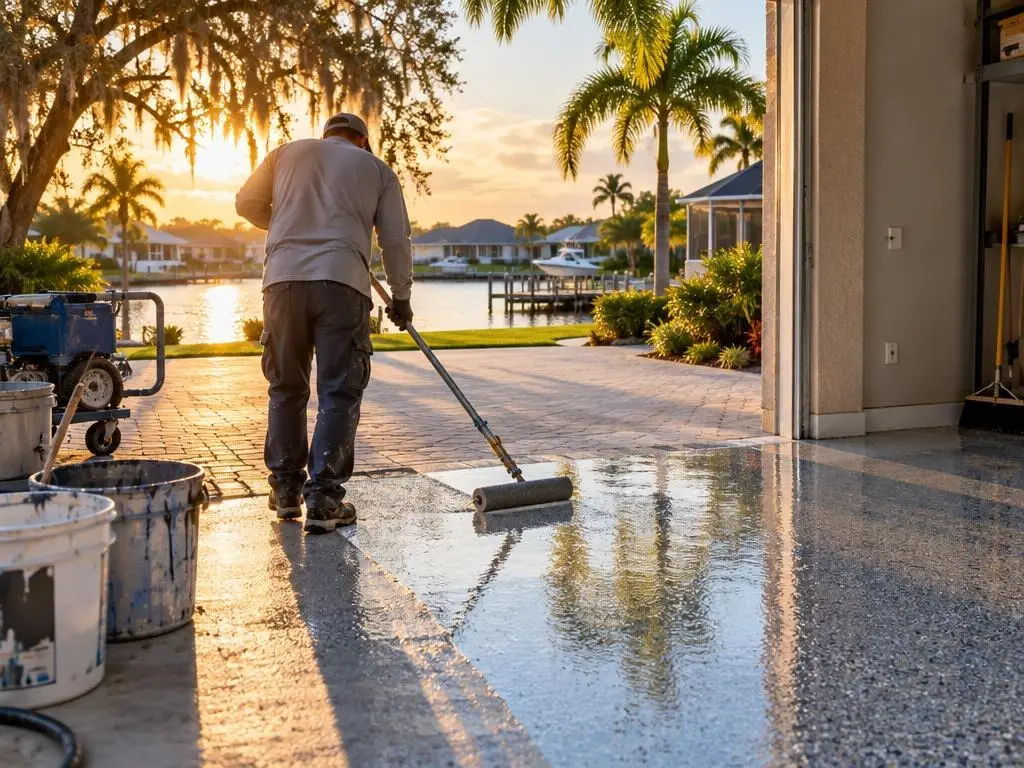
Primer if the slab needs it, then the epoxy base, applied after checking humidity, dew point and slab temperature.
5. Topcoat and cure times
A clear epoxy or polyaspartic topcoat, with grit where needed. We leave you with walk, move-in and parking times.
Why Choose Us for Epoxy Garage Floors
Prep is in the quote
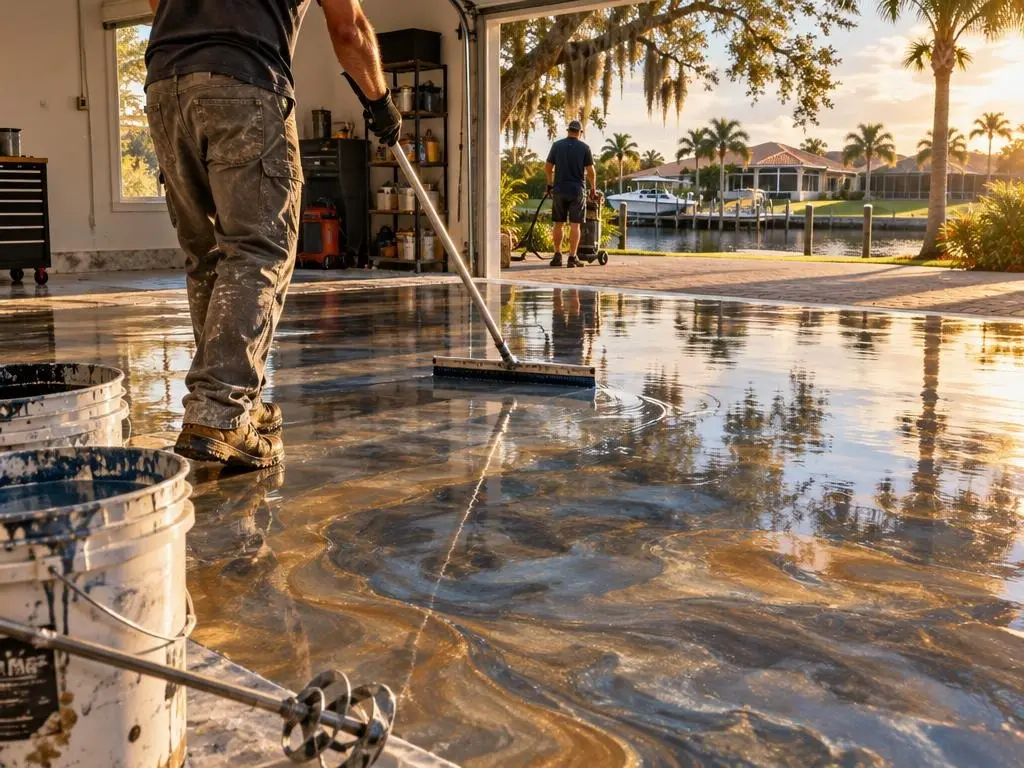
Grinding and crack repair each get their own line, so you can confirm they are being done.
Topcoat matched to sun
We ask which way the garage faces and how often the door is open before choosing the finish.
Weather-aware scheduling
Coats go down only when slab temperature is safely above the dew point.
Epoxy Garage Floors Questions
Is epoxy or polyaspartic better for a Tampa garage?
Often both. Epoxy gives you thickness for less money, and a polyaspartic topcoat adds UV resistance and a faster cure. For a sunny garage, that combination is our usual suggestion.
Can hot tires pull up an epoxy garage floor?
Hot tire pickup is mostly a problem with thin paint and one-part kits. A two-part system on a ground slab, cured fully before you park, holds up far better.
Will you coat right over the paint on my garage floor?
No. Paint and old kit coatings are a weak layer under a new floor. We grind them off so the epoxy bonds to the concrete.
Is an epoxy garage floor slippery?
Glossy, smooth coats get slippery underfoot when wet. Where tires and feet come in wet, we mix fine grit into the topcoat or use a flake finish.
What lifespan should I expect from an epoxy garage floor?
HomeGuide puts the lifespan of solid epoxy at 10 to 20 years and water-based products at 3 to 5. Prep, use and sun exposure make the biggest difference.
Epoxy Garage Floors Service Areas
- Epoxy Flooring in Tampa, FL
- Epoxy Flooring in Brandon, FL
- Epoxy Flooring in Riverview, FL
- Epoxy Flooring in Valrico, FL
- Epoxy Flooring in Plant City, FL
- Epoxy Flooring in Temple Terrace, FL
- Epoxy Flooring in Carrollwood, FL
- Epoxy Flooring in Town 'n' Country, FL
- Epoxy Flooring in Westchase, FL
- Epoxy Flooring in Lutz, FL
- Epoxy Flooring in Land O' Lakes, FL
- Epoxy Flooring in Wesley Chapel, FL
- Epoxy Flooring in Apollo Beach, FL
- Epoxy Flooring in Ruskin, FL
- Epoxy Flooring in Sun City Center, FL
- Epoxy Flooring in Seffner, FL
- Epoxy Flooring in Lithia, FL
- Epoxy Flooring in FishHawk, FL
- Epoxy Flooring in Odessa, FL
- Epoxy Flooring in Citrus Park, FL
- Epoxy Flooring in Thonotosassa, FL
- Epoxy Flooring in Zephyrhills, FL
- Epoxy Flooring in Gibsonton, FL
- Epoxy Flooring in Wimauma, FL
Get an Epoxy Garage Floors Estimate
Free Tampa garage floor estimates, slab moisture test included.