
Garages, lanais and work floors around Tampa Bay
Epoxy Flooring in Tampa, FL
Concrete coatings planned for Gulf Coast humidity, summer storms and hard Florida sun, installed over ground and repaired slabs.
- Free on-site estimates: we measure the slab and inspect it in person
- A moisture test on the concrete before the first coat
- Written quotes that spell out every prep step and coat
Floor Coatings That Fit How Tampa Lives
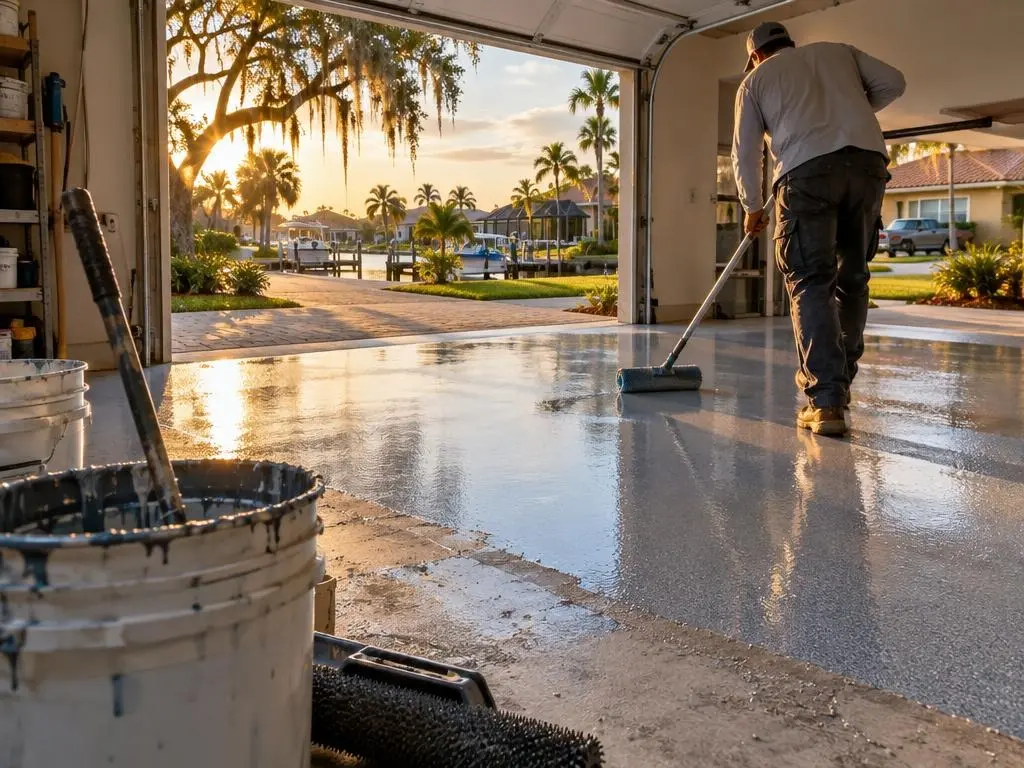
Epoxy flooring in Tampa, FL has a different job than it does up north. Wikipedia lists the city's climate as humid subtropical, with average highs running from 71 to 91 degrees through the year and about 49.5 inches of rain, most of it falling from June through September. Freezes are rare. What a Tampa garage floor actually fights is wet air, afternoon downpours, sand and grit, hot tires and, on any surface the sun reaches, ultraviolet light. Tampa Epoxy Flooring Pros builds each floor around those facts, whether it is a one-car garage in an old bungalow district, a three-car garage in a newer subdivision, a screened lanai or a warehouse aisle near the port.
Moisture is the first thing we test
The National Weather Service office for Tampa Bay has dew point records going back to 1948. The highest it lists for Tampa is 86 degrees, on August 6, 2000, and in August 2024 the dew point held at or above 75 for seven days in a row. When the surface of a slab is cooler than the dew point, water condenses on it. Put a coating over that film and you get blisters, cloudy patches and peeling. On install day we compare slab temperature with dew point before each coat. We also test the concrete itself for moisture coming up from below, because a slab can look dry and still push vapor into a new floor. If the numbers point that way, the floor gets a damp-tolerant primer, and if they are simply wrong for the day, we pick another date.
Sun, heat and the choice of topcoat
Standard epoxy makes a hard, thick base, but on HomeGuide's scale it scores only poor to fair for UV resistance, while polyaspartic scores excellent. Tampa sun is strong enough that a plain epoxy floor near an open garage door, on a lanai or around a pool can yellow and lose its gloss over time. For any floor that sees daylight, we finish the epoxy base with a polyaspartic topcoat that stands up to UV, or use a full polyaspartic system. Polyaspartic also cures much faster, which helps when afternoon storms roll in. Inside a closed warehouse or a garage that rarely has the door up, a full epoxy build can be the better value.
Heat matters too. Wikipedia notes that Tampa's official high first reached 100 degrees on July 27, 2025. A dark coating in a closed garage on a day like that gets very warm, and resin cures faster as it heats. Fast cure sounds good, but it shortens the time a crew has to roll a coat out evenly. In the hottest months we mix smaller batches, work the shaded side of the floor first and plan the order of the room so we never leave a hard edge in the middle of the floor.
Storm season and garage slabs
Hurricane season lasts from June 1 through November 30, and 2024 showed what it can do here. During Helene, the NWS measured a record 7.2 feet above mean higher high water at East Bay, and Wikipedia describes it as the worst storm surge in the Tampa Bay area in 100 years. Two weeks later, Milton dropped 11.43 inches of rain at Tampa International Airport in a single day. A garage that took on salt water or floodwater needs more than a quick rinse before any epoxy floor coating goes on. Salt and silt left in the pores can push a coating off from underneath. We wash, let the slab dry out, test it, and only then quote a system.
Old concrete, new concrete
Tampa grew in layers. Ybor City's cigar makers lived in small houses built in the 1880s, Seminole Heights started in 1911 as the city's first suburb of craftsman bungalows, and New Tampa began in 1988 when the city annexed about 24 square miles between I-275 and I-75. Many older slabs went down with no vapor barrier beneath them and may carry decades of paint, oil and patching. Newer slabs are usually tighter, but they can still have curing compounds or sealers on top that block a bond. In both cases the answer is the same: diamond grinding to clean, open concrete and proper crack repair before the first coat. We explain which prep your slab needs and why.
Questions to put to epoxy flooring contractors before you sign
Tampa has no shortage of epoxy flooring companies, epoxy floor installers and DIY kits on store shelves. Whoever you hire, ask a few plain questions. Will they test the slab for moisture? Will they grind the floor or just acid-etch it? Which product goes on as the topcoat, and is it rated for UV? How thick is each coat? How long before you can walk on it, and how long before you can park? Is the price in writing, with prep and repairs listed? A good answer to each of those tells you more about the finished floor than any photo gallery. We answer all of them in the written quote.
What epoxy flooring costs
National cost guides give a fair starting range. Installed epoxy comes in at $4 to $10 per square foot in HomeGuide's figures, with a two-car garage at $1,600 to $5,800, and polyaspartic at $5 to $12 per square foot. HomeAdvisor notes that many contractors have a job minimum of $500 to $1,000. Your own number will hinge on square footage, the amount of grinding and crack work, any old coating that needs stripping, and the system you pick. Flake and metallic finishes, thicker commercial builds and outdoor surfaces each change the number. We measure, test and give you one written price, and that price is the one you pay unless you approve a change.
Garage use around the bay
A lot of Tampa garages are not just for cars. With about 35 percent of the city's area covered by water, boats on trailers are common, and so are golf carts, kayaks, tools and fridges full of bait. Each of those changes the floor. Trailer jacks and tool chests can gouge a thin coat. Salt water dripping off a hull is hard on bare concrete. Golf cart batteries and lawn equipment can leak. We match the build to what you store, adding thickness, a textured topcoat for grip or a chemical-resistant finish where it is needed.
Planning for HOA and condo rules
Many neighborhoods around Tampa are deed-restricted, and some condo and townhome boards want to know about work that changes the look of a garage, driveway apron or shared walkway, or that brings a crew and equipment onto the property. Rules differ from one community to the next, so we do not guess. If your association needs a description of the work, product data sheets or the schedule before it signs off, tell us during the estimate and we will put together what it asks for.
Why Homeowners Call Tampa Epoxy Flooring Pros
We test before we quote
Every estimate includes a slab moisture check and a look at cracks, old coatings and stains, so the price reflects the floor you actually have.
Topcoats chosen for the sun
Floors that catch sunlight are finished with polyaspartic, either as the topcoat or as the whole system, so color and gloss last.
Install days planned around the weather
Before every coat we take humidity, dew point and slab temperature readings, begin early on summer days, and reschedule when conditions are off.
Everything in writing
The quote spells out the system, the coats, the prep, the repairs and the total. Nothing outside it gets done until you approve the change on paper.
Neighborhoods and Towns We Cover
We work across Tampa, from South Tampa, Hyde Park and Davis Islands to Seminole Heights, Westchase, Carrollwood and New Tampa, and throughout Hillsborough County, including Brandon, Riverview, Valrico, FishHawk, Plant City, Temple Terrace, Apollo Beach, Ruskin, Sun City Center and Town 'n' Country. North of the county line we cover Lutz, Land O' Lakes, Wesley Chapel and Zephyrhills. Bayfront and canal neighborhoods tend to need more attention to salt and storm water, while inland towns to the east see more cold nights in winter and more new slabs. Each town page covers what is different about its floors.
- Epoxy Flooring in Tampa, FL
- Epoxy Flooring in Brandon, FL
- Epoxy Flooring in Riverview, FL
- Epoxy Flooring in Valrico, FL
- Epoxy Flooring in Plant City, FL
- Epoxy Flooring in Temple Terrace, FL
- Epoxy Flooring in Carrollwood, FL
- Epoxy Flooring in Town 'n' Country, FL
- Epoxy Flooring in Westchase, FL
- Epoxy Flooring in Lutz, FL
- Epoxy Flooring in Land O' Lakes, FL
- Epoxy Flooring in Wesley Chapel, FL
- Epoxy Flooring in Apollo Beach, FL
- Epoxy Flooring in Ruskin, FL
- Epoxy Flooring in Sun City Center, FL
- Epoxy Flooring in Seffner, FL
- Epoxy Flooring in Lithia, FL
- Epoxy Flooring in FishHawk, FL
- Epoxy Flooring in Odessa, FL
- Epoxy Flooring in Citrus Park, FL
- Epoxy Flooring in Thonotosassa, FL
- Epoxy Flooring in Zephyrhills, FL
- Epoxy Flooring in Gibsonton, FL
- Epoxy Flooring in Wimauma, FL
Floor Coating Services
Six coating systems for Tampa garages, homes, outdoor living spaces and commercial floors.
Epoxy Garage Floors
A ground, crack-repaired garage slab sealed under a thick epoxy build and a topcoat suited to how much sun and water your garage gets.
Learn more →Flake Garage Floors
Vinyl color chips scattered into a wet resin base, then locked under a clear coat, for a textured floor that hides dust and adds grip.
Learn more →Polyaspartic Coatings
Quick-curing coatings that resist UV, so you get the floor back sooner and the color holds in sunny garages and outdoor spaces.
Learn more →Metallic Epoxy Floors
Pearlescent pigments worked through clear epoxy for a deep, marbled floor in living spaces, offices, studios and garages.
Learn more →Warehouse & Commercial Epoxy
Thick, chemical-resistant floor systems for warehouses, shops, kitchens, clinics and retail spaces, with striping and phased schedules.
Learn more →Patio, Lanai & Pool Deck Coatings
UV-stable, textured coatings for screened lanais, patios and pool decks, plus resurfacing for tired, stained or cracked outdoor concrete.
Learn more →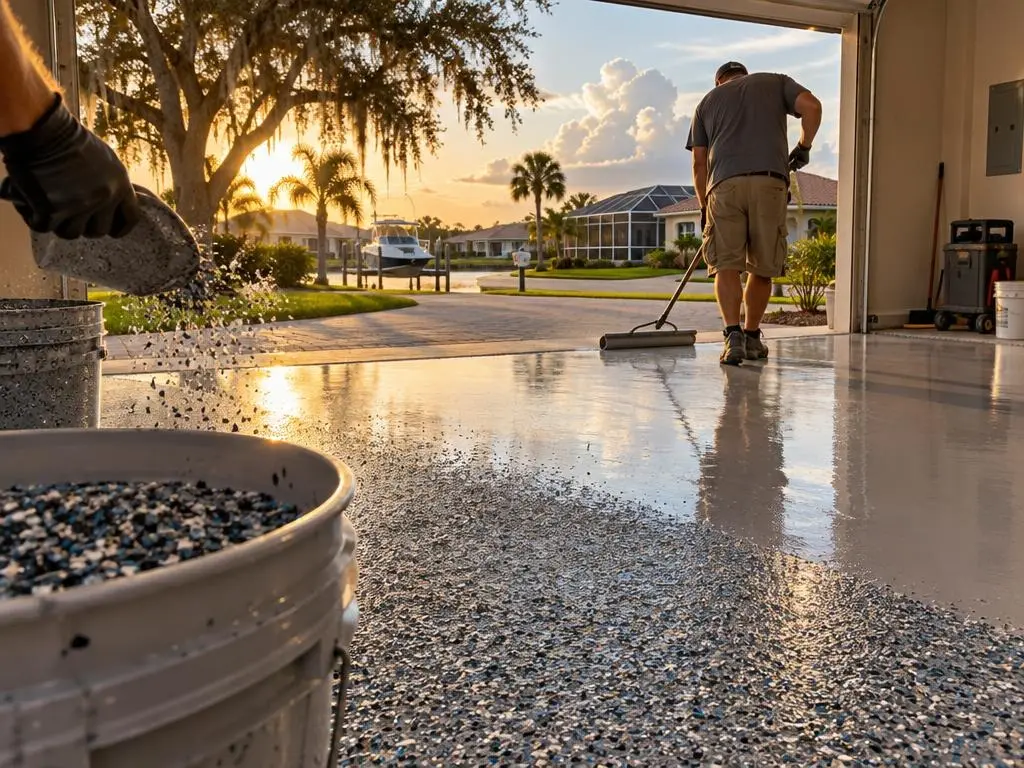
Common Questions
Is it expensive to epoxy your floor?
Expect more than paint and less than most tile jobs. HomeGuide prices installed epoxy at $4 to $10 per square foot and gives $1,600 to $5,800 for a two-car garage. The price moves with grinding, crack repair, stripping an old coating, and whether you go with flake, metallic or polyaspartic. Your written estimate is the real number.
What does epoxy cost for a 20x20 garage floor?
At 20 by 20 feet, the floor measures 400 square feet, roughly a smaller two-car garage. HomeGuide's two-car garage range is $1,600 to $5,800 for epoxy and $2,000 to $6,900 for polyaspartic. Where you fall depends on prep, repairs and the finish you pick, so we measure and quote it in writing.
How much does a 1,500 sq ft epoxy floor cost?
Bigger floors are generally priced per square foot. For epoxy, HomeGuide's range is $4 to $10 a square foot, and HomeAdvisor puts 100% solids systems for commercial or industrial use at $12 and up per square foot. Slab condition and the system your traffic calls for decide the final figure, which you get in writing once we have tested.
What is the downside of epoxy flooring?
Standard epoxy can yellow in sunlight, it takes longer to cure than polyaspartic, and a glossy finish gets slick when wet unless grit or flake is added. It also fails early if the slab is damp or poorly prepared. We answer each of these with moisture testing, grinding, a topcoat rated for UV, and added texture wherever grip matters.
Can you install epoxy during Tampa's rainy season?
Yes. Summer jobs usually begin early in the morning so each coat can set before the afternoon storms, and the garage door stays closed during the cure. Before every coat we compare the dew point with the slab's temperature, and if the readings say the floor will not bond, we reschedule.
When can I drive onto my new garage floor?
That comes down to the system and the weather. Per HomeGuide, polyaspartic can handle heavy vehicles after about 24 to 48 hours, whereas epoxy can need up to seven days for a full cure. Before we pack up, we tell you when it is safe to walk on, when furniture and storage can go back, and when to park.
My garage flooded in 2024. Can it still be coated?
Usually, yes. Flood or surge water can leave salt and silt in the concrete, so we clean the slab, let it dry and test the moisture before choosing a system. Damaged or pitted areas are repaired first. If the slab has an issue that coating cannot fix, you will hear it from us.
Ready for a Floor Built for Tampa Weather?
Get a slab test and a price in writing at a free on-site estimate.